
One number for production readiness.
Bao's dashboard collapses six categories of signal — security, reliability, observability, dependencies, performance, posture — into one score per repo and one forecast per environment.
02 — WHAT BAO DOES
Watch. Score. Fix. Approve.
Four jobs, in order, on every repo Bao watches.
01
Watch
Bao reads your code, your deploys, your dependencies, and your runtime — through OAuth, read-only, no agent. New signals land continuously.
02
Score
Six categories of signal collapse into one Production Readiness Score per repo and one days-until-break forecast per environment.
03
Fix
When something is broken, Bao writes the diff with a plain-English reason. P1 needs attention today. P2 is on the list. P3 is drift you can plan for.
04
Approve
Read-only by default. Every PR, Slack message, or ticket Bao opens waits on a human approval. Auto-approve is opt-in, scoped, reversible.
03 — OVERVIEW
This is what your team sees on Monday morning.
The overview is one screen: every repo, every team, the readiness score, the forecast, the top risks, the recent alerts. No tabs. No drill-down required to know whether you can deploy today.
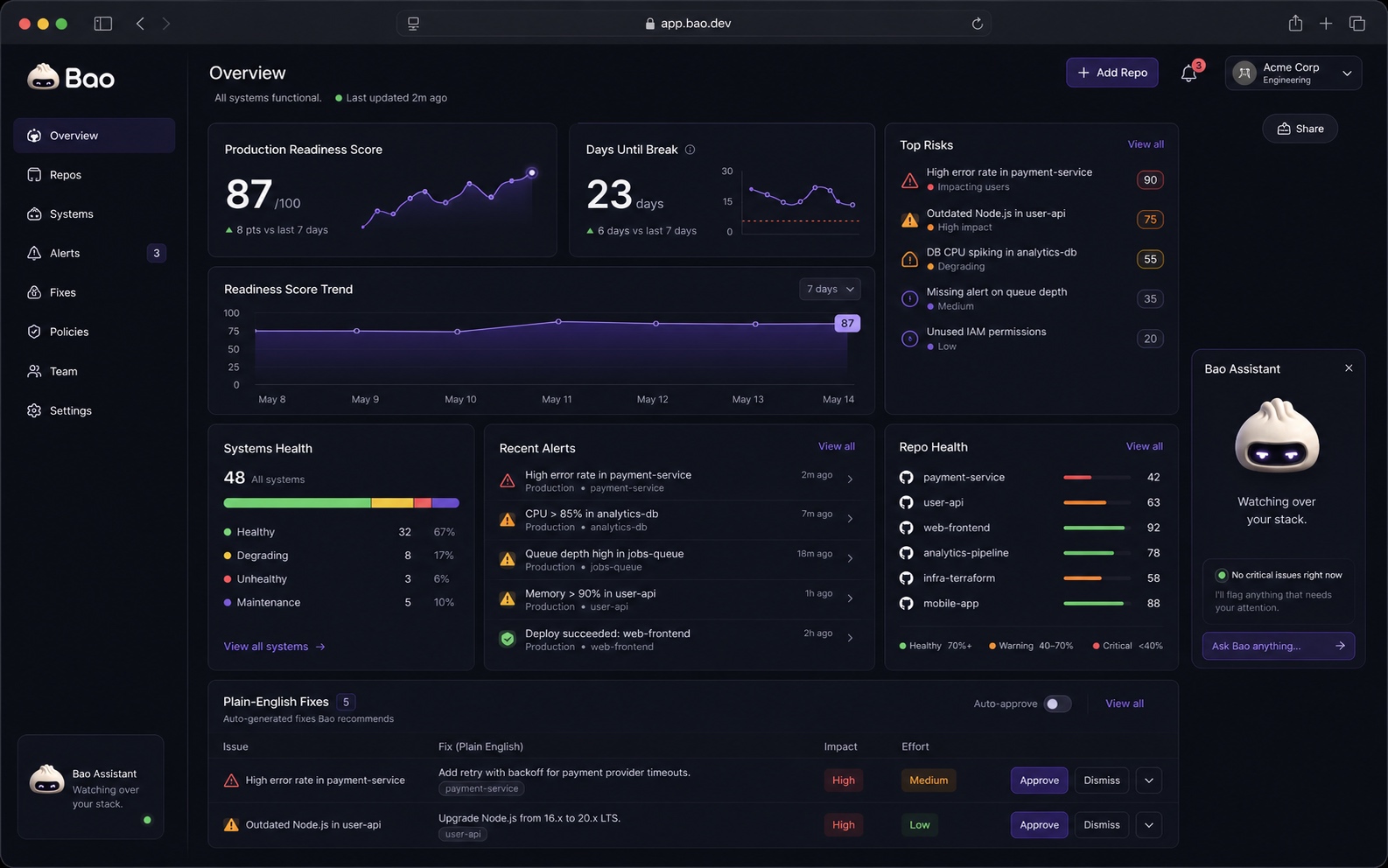
app.bao.dev — Overview
04 — APPROVALS
Read-only by default. Approval required for every write.
Bao opens PRs, posts Slack messages, and writes Linear tickets only when a human approves. On Team and above, you can auto-approve low-risk fixes (formatting, dependency bumps without breaking changes, doc updates) — but the policy is yours, not ours. Every approval is logged. Every action is reversible.
05 — INTEGRATIONS
The eight integrations that matter.
Each ships with first-class signal extraction. Bao knows the shape of these tools and reads them deeply.
See all integrations →Native
GitHub · Vercel · Supabase · Cloudflare · Stripe · Sentry · AWS · Render
Run Bao against your hardest repo.
The first finding lands in three minutes. The first PR can wait until standup.